
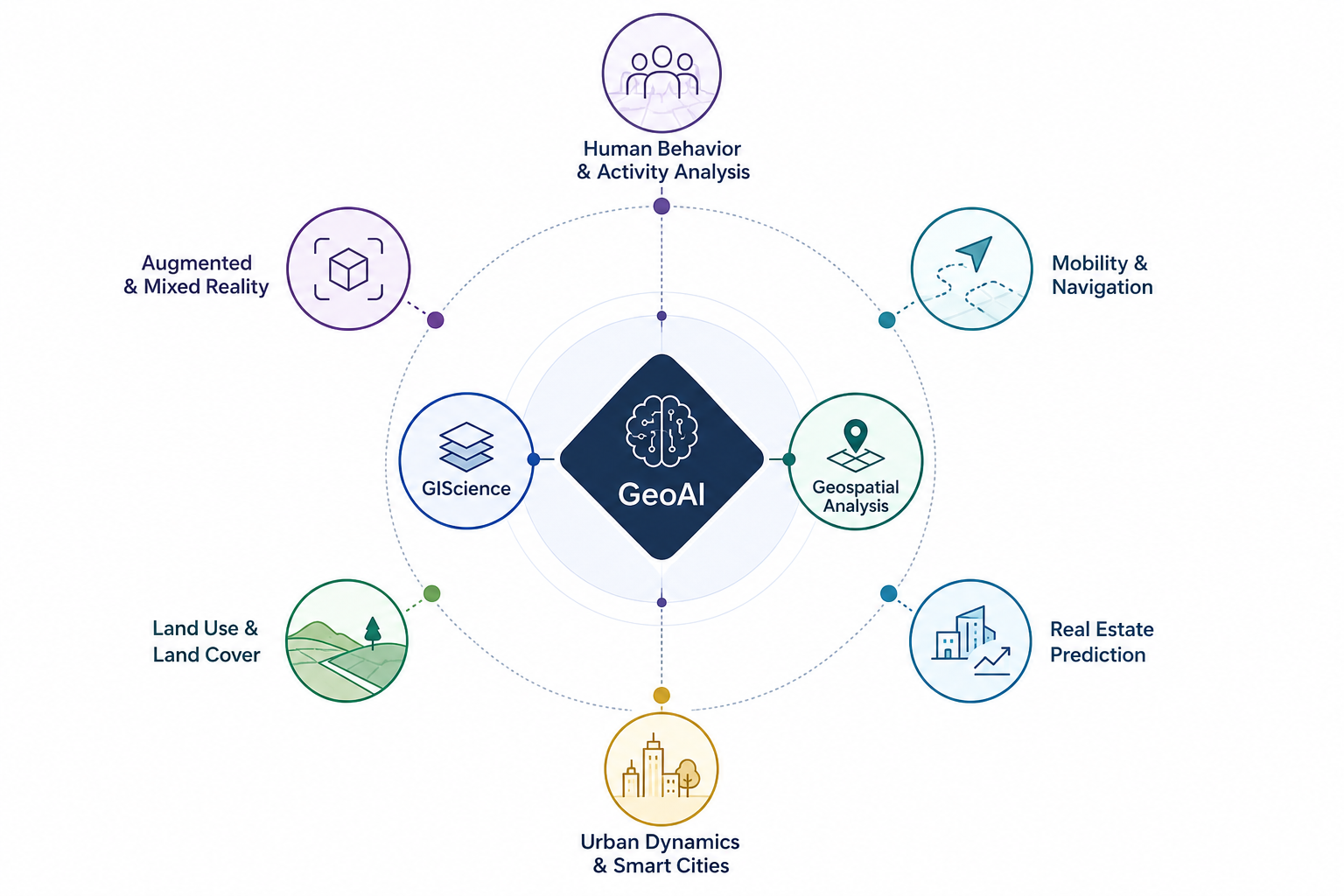
Our Main Research Domains...
We explore the science, analysis, and intelligence of geographic information to better understand how people, places, and environments interact. Our research spans the full spectrum of GIScience, from spatial data modeling and geospatial analytics to cutting-edge GeoAI methods that leverage machine learning and artificial intelligence for spatial understanding and prediction. By combining geospatial data, human-centered computing, and AI, we address real-world challenges in domains such as human behavior and activity analysis, mobility and navigation, augmented and mixed reality, land-use and land-cover monitoring, urban dynamics, real estate valuation and prediction, and sustainable spatial planning.
GIScience
Geographic Information Science (GIScience) investigates how spatial information is represented, collected, integrated, and communicated. We develop methods to model geographic entities, spatial relationships, uncertainty, and semantics across diverse data sources, including remote sensing, mobile sensors, volunteered geographic information, and location-based services.
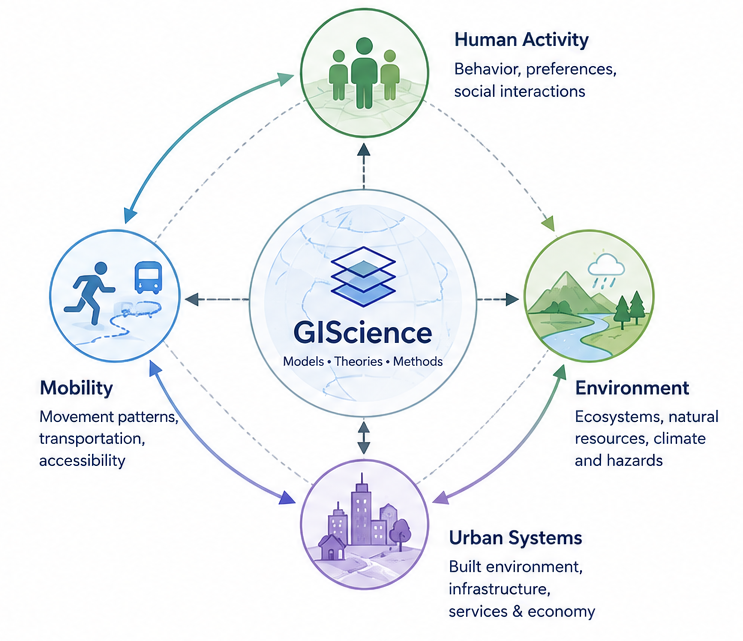
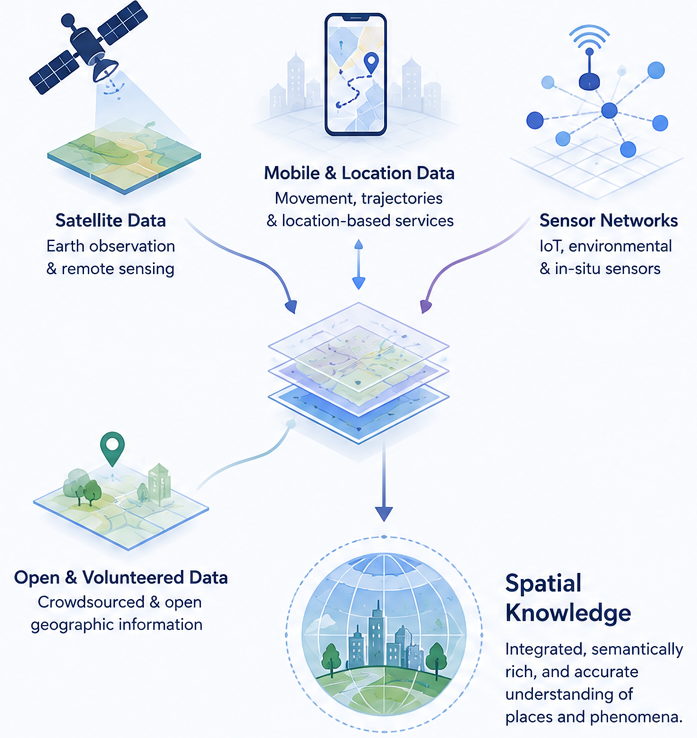
Our research focuses on transforming heterogeneous geospatial data into meaningful spatial knowledge, enabling a deeper understanding of places, environments, and human activities. By studying the fundamental principles of geographic information, we create robust foundations for spatial analysis, decision support, and intelligent geospatial systems.
GeoAI
Learning Spatial Representations
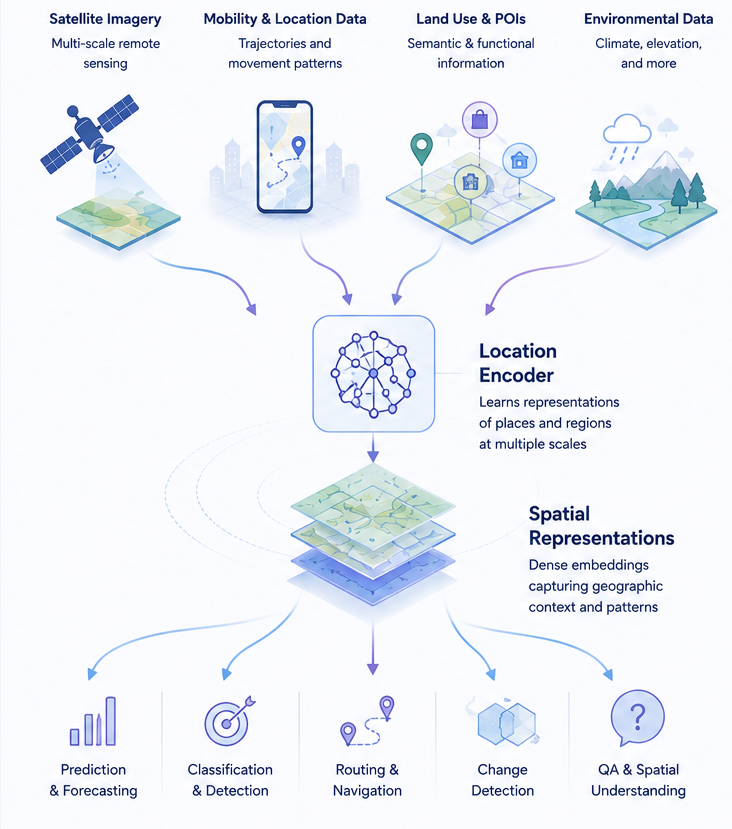
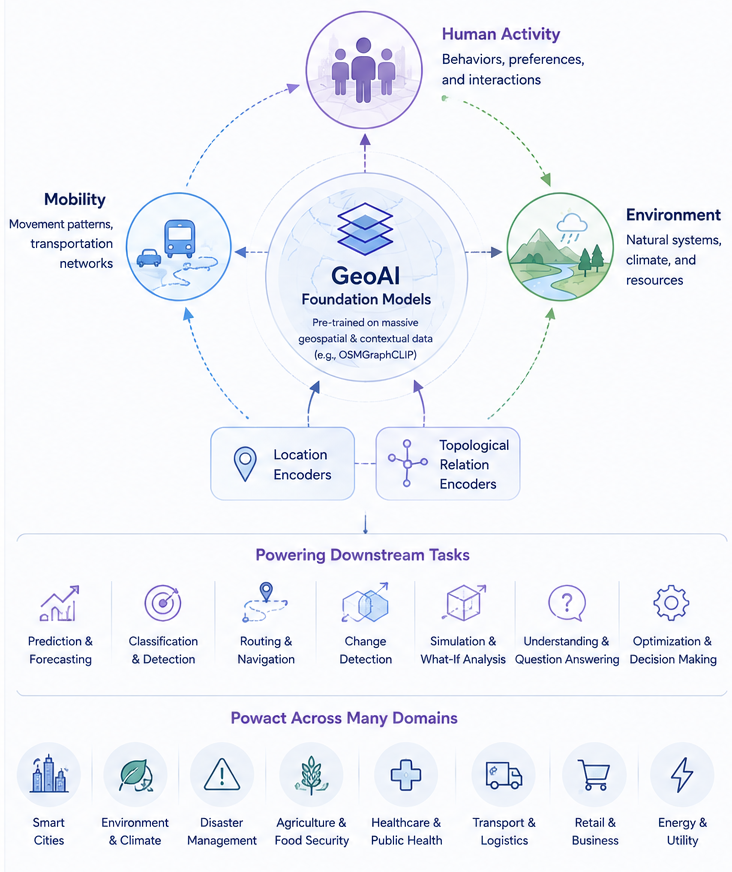
GeoAI enables machines to understand geographic space by learning meaningful representations from locations, places, and spatial relationships. Traditional AI models often treat geographic coordinates as simple numerical inputs, overlooking the rich context embedded in space. Our research develops advanced location encoders, spatial embeddings, and representation learning techniques that capture multi-scale geographic patterns, environmental characteristics, human activities, and spatial dependencies.
By transforming geographic information into machine-readable representations, we enable AI systems to become spatially aware and capable of understanding where phenomena occur, how places differ, and how spatial context influences real-world processes.
Spatial Reasoning and Geospatial Foundation Models
We develop GeoAI systems that move beyond pattern recognition toward genuine spatial understanding and reasoning. Our research explores topological relation learning, spatial reasoning, graph-based geographic intelligence, and geospatial foundation models trained on large-scale geographic data. These models learn how places relate through connectivity, adjacency, hierarchy, containment, movement, and interaction.
By integrating representation learning with foundation models and spatial reasoning, GeoAI can support complex downstream tasks such as prediction, routing, navigation, environmental monitoring, decision support, simulation, and question answering. Our goal is to transform AI from location-agnostic systems into geographically intelligent agents capable of understanding and reasoning about the world.
Mobility
Understanding Human Behavior in Space
Human activities continuously shape and are shaped by the environments in which they occur. Our research investigates how people perceive, navigate, interact with, and experience geographic space across physical and digital environments. By combining spatial data, behavioral analytics, and immersive technologies, we seek to better understand human decision-making, movement patterns, spatial cognition, and place-based experiences.
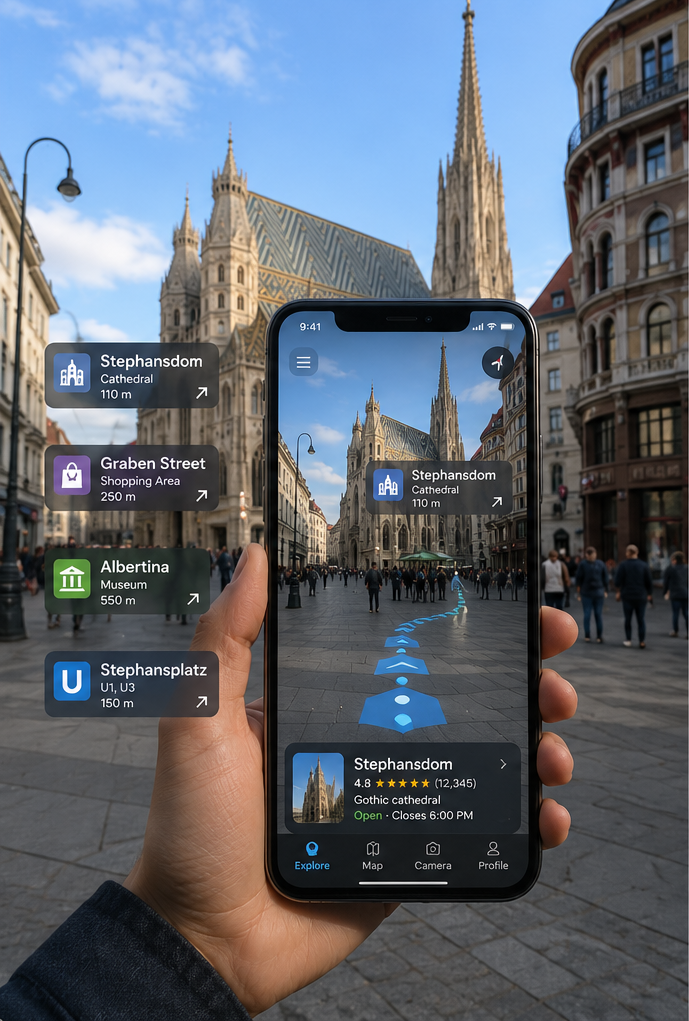
A particular focus lies in the integration of geospatial technologies with Human–Computer Interaction (HCI), Extended Reality (XR), and Augmented Reality (AR). Through novel spatial interfaces and context-aware systems, we explore how digital information can be seamlessly embedded into the physical world, enabling more intuitive interactions with places, environments, and geospatial data. This research forms the foundation of our SpatialHCI Lab, where we investigate the future of human-centered geospatial experiences.
Mobility Analytics and Urban Intelligence
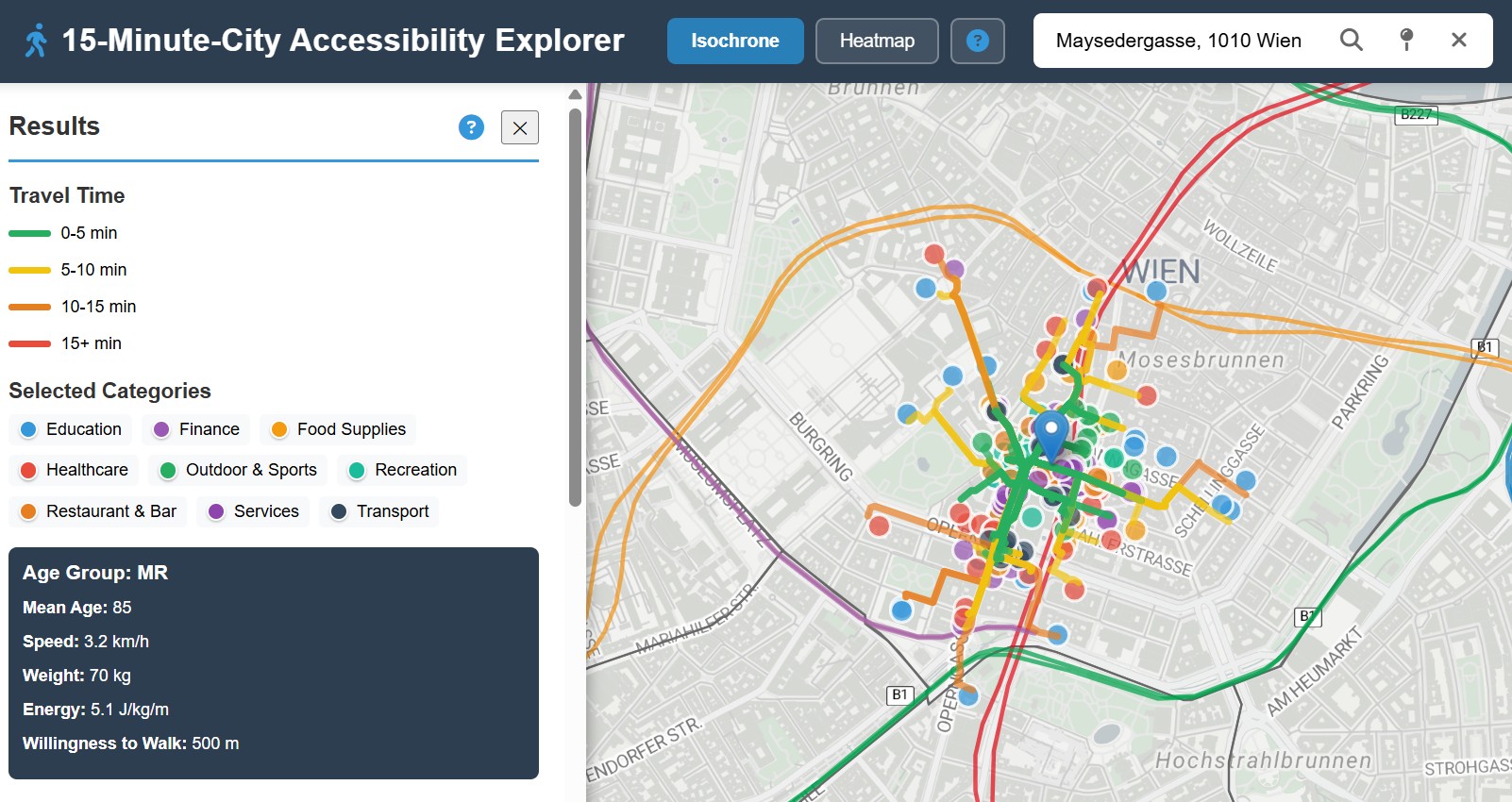
Cities generate vast amounts of mobility data through transportation systems, mobile devices, sensors, and location-based services. We develop methods to analyze movement patterns, accessibility, transportation behavior, and urban dynamics across multiple spatial and temporal scales. Our work combines GIScience, spatial analytics, and GeoAI to uncover how people move through cities and how urban systems evolve over time.
By leveraging large-scale mobility data and advanced geospatial modeling techniques, we support applications ranging from sustainable transportation planning and accessibility assessment to smart-city development and urban resilience. This research is closely connected to the XMo Lab, where we study human mobility, urban analytics, and data-driven approaches for understanding and improving complex urban systems.